

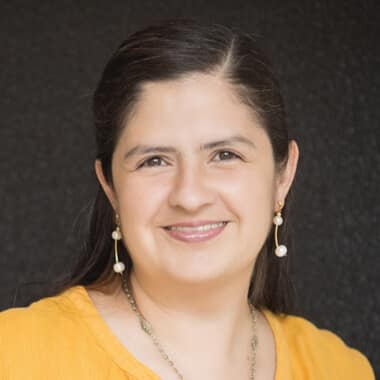
Maria del Mar Cepeda Garcia

Job Title:
Coordinadora Bebras México
Company - Organization:
Coordinadora Bebras México
Experience:
24 Years
Education:
Bachelor's Degree in Mechanical Engineering
Universty - College:
Universidad la Salle
Nationality:
Mexican

Your organization field and mission:

The mission of the Comité Mexicano de Informática (COMI) is to promote computer science and computational thinking among students across Mexico. Through initiatives like BebrasMX, and Mexican Olympiad in Informatics, COMI seeks to inspire curiosity, problem-solving, and logical reasoning in children and young people, providing them with free and accessible challenges that strengthen their digital skills and prepare them for the technological future.

Please tell us briefly about your role in the company / at your organization:

I was a former participant in the Mexican Olympiad in Informatics, the International Olympiad in Informatics, and the International Physics Olympiad (1996–1997). Since then, I’ve volunteered in training students and organizing the national competition. Professionally, I’ve worked as a Project Manager in both the food industry and in IT and technology solutions.

My personal interest in STEM education at the primary level grew stronger when my children entered that stage, and it has continued ever since. In 2023, I helped bring the Bebras Challenge to Mexico to promote computer science and computational thinking nationwide. I also coordinate an extracurricular science program where I teach physics and chemistry to children ages 6–12.

Your interest in STEM

I come from a family of engineers—my father, mother, grandparents, most of my uncles, and my siblings are all in STEM fields. Since I was little, I was encouraged to observe and analyze the world around me. My dad would tell me stories about “the Prince of Mathematics” on our way to school and challenge me to think critically about everyday phenomena—like why the rear windshield doesn’t get wet while driving in the rain.

On the other hand, my mother was an electronics engineer at a time when very few women pursued that path. She was also a highly respected professor at the Instituto Politécnico Nacional in Mexico, one of the country’s most prestigious engineering universities.

I was fortunate to grow up in an environment where STEM was never seen as something only for men. I saw both women and men in my family deeply involved in science and technology, and for me, it always felt completely natural to belong in that world.

So, I guess you could say my interest in STEM has been part of my life since birth. I’ve always loved solving problems, finding creative solutions, and understanding how things work. For me, engineering is not just a career—it’s a way of life and an absolute joy.

My first role models—and still the most important ones—were my parents. Later on, my older siblings also became people I deeply admired and looked up to. I’ve been very fortunate to find great role models throughout my professional life as well. My managers in every job I’ve had have been excellent mentors and guides—some of them even became close friends. They not only supported my growth but also inspired me to become a better professional and a better person.

Your studies

During my studies, one of my main strengths was the solid foundation I received at home in math and physics. From an early age, I was encouraged to understand how things work and to believe in my ability to solve problems. That confidence and curiosity became essential throughout my academic journey.

In terms of weaknesses, I sometimes found it challenging to work in teams or adapt to very different teaching styles. I was used to learning in a very analytical and self-driven way, so it took me time to adjust to collaborative settings or classes that relied more on memorization or less structured approaches. I also realized I could improve on asking for help when needed, as I often preferred solving things on my own.

Among the most important opportunities I had were the national and international science Olympiads in physics and informatics. These experiences allowed me not only to travel and represent my country, but also to gain perspective on the academic level and educational systems in other countries, which further motivated me to grow.

As for threats, I didn’t face major external obstacles, but one of the biggest challenges was time management. My university schedule was intense—classes from 7 to 9 a.m. and again from 6 to 10 p.m.—and in between I was involved in many other activities. Without realizing it, the physical and mental overload eventually took a toll on my health. It was a difficult but valuable lesson about balance and self-care.

My advice to girls and women who want to pursue studies in STEM is simple: follow your dreams. Believe that you are capable of achieving whatever you set your mind to—because you are. Don’t overthink the fact that you’re a woman, and don’t feel you need to act like a man to succeed. Just be yourself.

One of the most important lessons I learned early in my career—especially when entering the industry—was that being kind, open to learning, and respectful of everyone’s experience made a big difference. I often found that people were more willing to help when I approached them with curiosity and humility, regardless of their role or background.

Yes, there will be moments when you encounter people with outdated or sexist beliefs. I was lucky that in my case, they were few. But I also learned not to give them power or space in my mind. If possible, walk away and surround yourself with people who see your potential and support your growth. In the end, doing your work well speaks louder than any prejudice. The first step is believing in yourself, and the second is supporting one another.

I’ll never forget a moment from my first year of university. I was the only woman in my program—not just in my class, but also in the years above and below. One day, a group of women came to find me. They were from other cohorts in the same major, and they invited me to breakfast. They told me that, since there were so few women, we needed to stay connected and support one another. They offered advice and said I could count on them. I never actually needed to ask for help, but just knowing they were there gave me a deep sense of peace and confidence—and I will always be grateful for that.

You at work

At COMI (Comité Mexicano de Informática), we have always strived to foster diversity and inclusion. While girls remain a minority among those who qualify for national competitions, we are proud to be one of the countries with the highest number of female participants at the International Olympiad in Informatics (IOI). One of the reasons I love the Bebras Challenge is that it shows a much more balanced level of participation between boys and girls. This creates a valuable opportunity to advance gender inclusion from an early age in computational thinking and computer science.

In my previous work in the food industry at PepsiCo, I was fortunate to be part of an organization with strong programs in inclusion and sustainability. I had access to great career development opportunities, and being a woman actually became an advantage, as the company was actively working to improve gender equality. I received strong support during motherhood through excellent maternity programs.

I also coordinated the environmental sustainability initiatives for several years and witnessed firsthand the company’s genuine commitment to making a positive impact. It wasn’t just about meeting targets—it was about driving real change. These experiences have shaped my belief that DEIS values are not only necessary but also powerful drivers of innovation, community, and long-term success.

I’m proud of many things throughout my career. In the industry, I take great pride in the projects I successfully led from beginning to end. Looking back, I see project coordination a bit like raising children—you nurture an idea, plan for it, bring it to life, help it grow, and eventually hand it over to someone else. Being able to contribute so much to something and watch it become real has always fascinated me. Applying both my technical knowledge and engineering intuition to make those projects as successful as possible has been deeply fulfilling.

One project stands out—not because it was completed, but because it wasn’t, and that turned out to be the right decision. I was asked to implement a methodology called early involvement, which required bringing together everyone who would eventually be part of the project, even from different departments, from the very beginning. It was a huge effort to coordinate people for something that was still just a concept, but by doing so, we conducted a much deeper analysis than usual. As a result, we realized that the project wouldn’t deliver the expected economic benefits. Thanks to that thorough early evaluation, the company avoided a costly mistake. It made me proud to see how the right process, even if challenging, could lead to such a valuable outcome.

On the other hand, in my volunteer work with COMI, I’m especially proud of the long-term impact we’ve had on young people through the Mexican Olympiad in Informatics. We recently celebrated its 30th anniversary, and seeing how many former participants’ lives were positively shaped by their experience in the competition is truly heartwarming. Being part of something that has opened doors and inspired so many talented students is, without a doubt, one of the things I cherish most

Your point of view

I believe that knowledge and technology have the power to empower not only women, but anyone—and that’s why we should actively seek them out.

Technology is a tool, and tools help us do things better, faster, or in ways we couldn’t before. The more tools we learn to use, and the better we understand when and how to use them, the more empowered we become. For women, gaining access to and confidence in using technology can open doors to education, careers, financial independence, and innovation.

Technology moves fast—and with the rise of artificial intelligence, that change is now even faster and harder to predict. It can be overwhelming, but like any tool, it can be used to improve lives. As women, we should embrace that potential. Learning to navigate and shape the digital world is not just a matter of opportunity—it’s a way to ensure we have a voice and agency in the future that’s being built.

My advice to girls and women who want to work in STEM is: go for it—believe in yourself and your abilities. You don’t need to change who you are to succeed. You don’t need to act like a man or hide the fact that you’re a woman. Just be confident in your curiosity, your problem-solving skills, and your passion for learning.

Surround yourself with people who support you, and don’t waste energy on those who don’t believe in your potential. When you do your work well, it speaks for itself. Recognize your value, and lift up other women around you—community and mutual support are powerful.

Also, never underestimate the value of being kind, humble, and open to learning. In my experience, these qualities made it easier to build strong relationships and grow in male-dominated spaces. And remember: you’re not alone. Even if you’re the only woman in the room, there are others who came before you—and many more who will follow your lead.

My advice to girls and women who want to work in STEM is to go for it with confidence. Believe that you can do it—because you can. Don’t hold yourself back by thinking you don’t belong, and don’t try to be someone you’re not. You don’t have to act like a man to succeed; you just have to be yourself. In my experience, being open, kind, and eager to learn helped me build strong professional relationships, even in male-dominated environments. Seek out mentors, stay curious, and don’t be afraid to ask questions. Surround yourself with people who support your growth, and don’t waste time trying to convince those who don’t.

Also, support other women. One of the most meaningful experiences I had was being welcomed and encouraged by a small group of women in my university program. Even though I never needed to ask them for help, just knowing they were there gave me strength and peace of mind. When you do your work with passion and commitment, you will be recognized. But the first step is to recognize your own worth—and to keep lifting others as you rise.

To finish with

My core values include curiosity, creativity, perseverance, humility, and integrity. I believe in the power of knowledge and education to transform lives, and I value environments where people are encouraged to learn, ask questions, and grow—regardless of their background or identity.

Congruence is especially important to me—acting in alignment with what I say and believe. I try to live by the idea that we must be the change we want to see. If we want a more inclusive and equitable world, we have to start by including others, sharing opportunities, and doing our part to level the playing field.

I also value kindness, collaboration, and community. I’ve seen firsthand how much stronger we are when we support one another—especially as women in STEM. And I believe that when we lead with empathy, respect, and consistency, we not only earn trust—we create space for others to thrive too.

One of my main future challenges is to continue helping others grow—to keep sharing what I’ve learned and what I know how to do. I truly enjoy contributing to the development of others, especially young people interested in STEM, and I hope to keep finding opportunities to do so in meaningful ways.

At the same time, I believe that the professional future for all of us is becoming increasingly complex, especially with the rapid changes brought by technology. One of the biggest challenges will be to stay flexible, adaptable, and open to learning, as the world is evolving at an incredible pace.

Staying relevant and continuing to add value in a constantly shifting landscape will require not just technical skills, but also creativity, emotional intelligence, and collaboration. And I’m ready to face that challenge.

By 2030, I hope to see Bebras fully established in Mexico as a widely recognized and valued initiative—one that teachers across the country actively seek out and support at all educational levels. I would also like Bebras to become self-sustaining, with enough committed people involved so that the project can continue and grow independently, even if I step back or take on a smaller role. I believe true success lies in building something that doesn’t depend on a single person.

In addition, I hope to find new ways to apply my skills and the latest technologies to projects that support my community in a sustainable and meaningful way. As tools and challenges evolve, I want to keep contributing to initiatives that promote education, inclusion, and equal access to opportunity.