


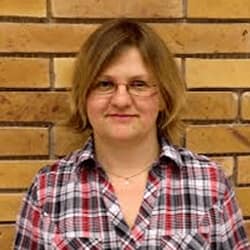
My family supported my first steps — the bedtime stories were often from Cyberiad by Stanisław Lem, nurturing my curiosity and sense of creativity from an early age. At home, I was surrounded by an engineering-oriented way of thinking, which shaped my analytical mindset.
My scientific career began in 1997, when I worked as a student assistant at the EuroLogo Conference, where I was first introduced to the international community of computer science education researchers.
Your organization field and mission:
This is the youngest faculty (2003) of the oldest Hungarian university (1635). Almost 3000 students decided to study computer science here. Typically, we receive four times as many student applications as there are available places. The highly qualified academic staff guarantees a high standard of training. The teaching is supported by modern infrastructure and well-equipped computer labs (artificial intelligence, databases and robotics).
Please tell us briefly about your role in the company / at your organization:
At the Faculty of Informatics, Eötvös Loránd University (ELTE), I am involved in course development and teaching within both the Hungarian and English study programs. My academic activity includes designing, updating, and delivering courses across computer science and teacher training programs, focusing on programming, computational thinking, robotics, and digital pedagogy. I regularly contribute to curriculum innovation and methodological renewal, supporting students’ learning in both undergraduate and postgraduate programs. In addition to teaching, I supervise theses and participate in educational development initiatives aimed at improving the quality and effectiveness of informatics education.
My research focuses on the assessment and development of Computational Thinking (CT) through unplugged activities, as well as programming- and robotics-based approaches. This work connects closely with my long-term involvement in the international Bebras community, where I have been an active member since 2010, contributing to task design, research collaborations, and joint publications with colleagues. My academic contributions include numerous conference papers, journal articles, and book chapters, as well as serving on program committees of national and international conferences.
Your interest in STEM
My father and mother :)
Professors: Benő Csapó, Valentina Dagiene
Your studies
One of my biggest challenges during my university years was becoming actively involved in research and international academic communities. Joining research projects and assisting at conferences opened up a completely new world to me — one that went far beyond the boundaries of classroom learning. It required me to develop new skills in communication, collaboration, and critical thinking, while also finding my own voice as a young researcher. Although it was initially challenging to adapt to the academic culture and expectations, this experience was transformative. It broadened my professional perspective, connected me with inspiring mentors and colleagues, and confirmed my commitment to contributing to the field of computer science education through research and innovation.
Experiment freely, don’t be afraid to dive into new things. But recognize when you need to step back or find a new path.
Join research groups or connect with people whose work seems interesting. Help out and volunteer boldly in activities you enjoy, even if they are a bit outside your usual focus.
You at work
At ELTE Faculty of Informatics, several initiatives support Diversity, Equity, Inclusion, and Sustainability (DEIS), including programs for international collaboration, courses raising awareness about diversity, and support systems for students from varied backgrounds.
To contribute meaningfully to the Bebras community and, based on the quality and impact of my work, to serve on the board and participate in research groups. To successfully promote the e-Hód (Hungarian Bebras initiative) by incorporating feedback from colleagues, teachers, and students.
Your point of view
Technology is not just a tool; it’s a multiplier. It expands opportunities, reduces barriers, and gives women the means to shape their lives, careers, and communities.
Professional networks give women a platform to showcase their work, ideas, and achievements.
Platforms allow (not only) women to learn new skills—from coding to finance—regardless of location.
The same as my advice in studies :)
Gender, ethnicity, or socioeconomic background no longer determines opportunities in education or ICT/CT careers.
Schools, universities, and ICT/CT organizations cultivate cultures that value and respect diverse perspectives.
STEM, ICT, and CT education are accessible to everyone, regardless of location or financial means.
Technology and curricula are designed with fairness, transparency, and societal benefit as priorities.
Diverse teams collaborate across borders to address global challenges like climate change, educational access, and digital skills.
Cross-cultural understanding and equitable participation drive innovation that benefits everyone.
To finish with
Positivity, openness, thoroughly examining and considering problems before taking action, and critical thinking.
My future challenges include continuously developing my expertise while adapting to rapidly evolving technologies, balancing critical analysis with decisive action, and fostering collaboration across diverse teams. I aim to maintain openness to new ideas while ensuring that decisions are well-considered and evidence-based.
Support my children and students to be positive and successful. :)
By 2030, I envision a career where I continue collaborating with curious, driven researchers, exploring compelling topics, and embracing challenges that push the boundaries of knowledge and innovation.